- Your cart is empty
- Continue Shopping


Uncategorized
Misconception: OKX is “just another exchange” — why that understates how its spot, margin and futures mechanics change trading decisions
-
By spbazaar
- Posted on
- 0 comments
Many U.S.-based traders hear “OKX” and think simply of another platform to buy Bitcoin or trade altcoins. That framing is useful but incomplete. OKX combines a full-featured centralized exchange (CEX) with a Web3 wallet, a DEX aggregator, staking and derivatives — and those structural layers interact in ways that change how you enter, size, hedge, and exit positions. This article uses a concrete case — an experienced U.S. trader switching a swing position from spot into a hedged futures stance — to show the mechanisms, trade-offs, and operational limits you should know before you log in.
We will focus on how spot trading, margin, and futures on OKX are designed to work together (and where they do not). I will explain the underlying mechanics that matter for real trades, clarify where common assumptions break down, and give decision-useful heuristics you can apply immediately when you next okx login to manage risk or seek leverage.
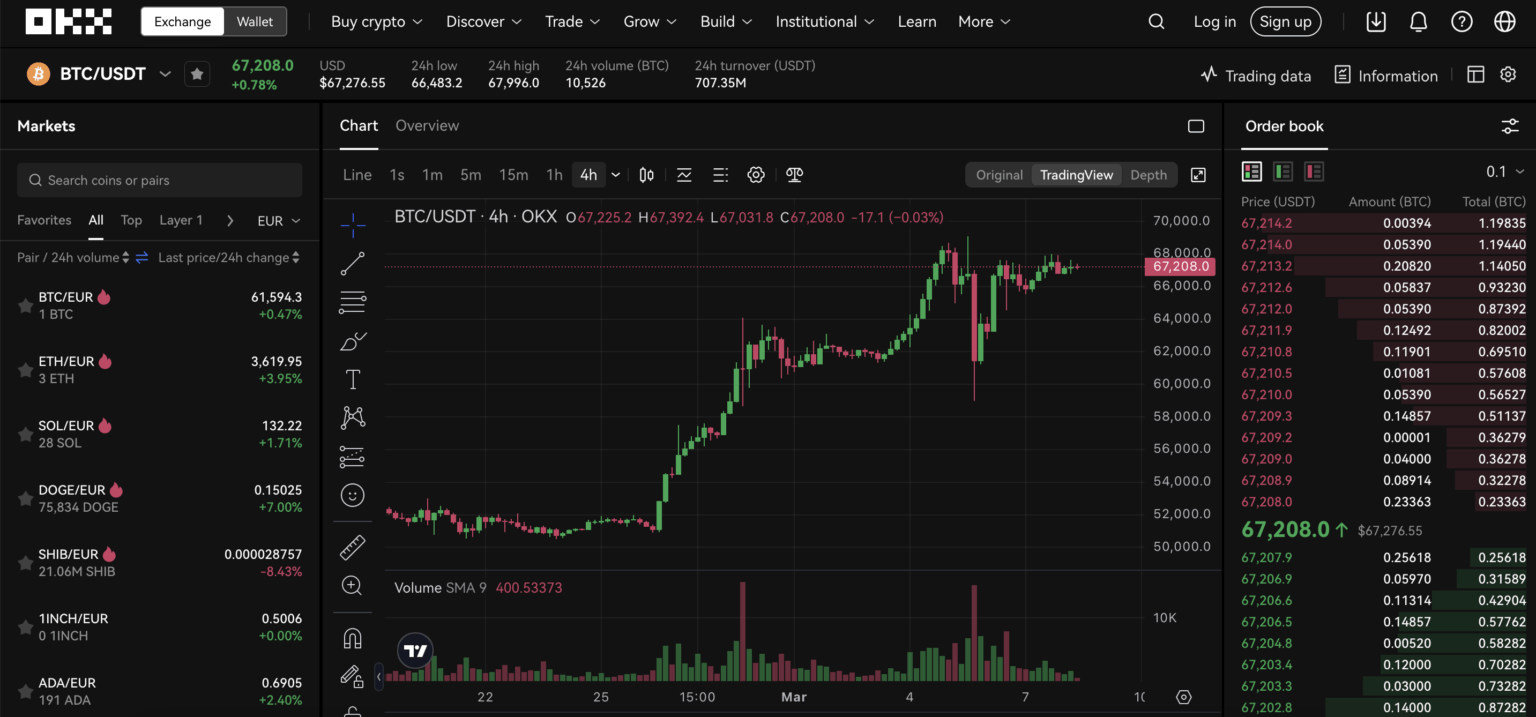
Case scenario: hedging a BTC spot long with OKX perpetuals — the key mechanics
Imagine you are long 1 BTC in your OKX spot account and you expect near-term volatility but do not want to sell. A common play is to open a short position in perpetual futures to hedge. Mechanically, OKX supports this across product types: spot balances sit in your CEX wallet, margin borrowing allows leveraged spot exposure (up to 10x), and perpetual futures or quarterly contracts can be used for hedges with up to 125x leverage on some assets. Understanding three internal mechanisms will determine whether the hedge behaves as you expect.
First, internal margin and cross-account settlement. On OKX, margin modes (isolated vs. cross) govern how losses consume capital: cross-margin shares collateral across positions, which can be efficient but increases contagion risk; isolated margin limits losses to the position but needs active management. If you use a perpetual to short while keeping spot in a separate sub-account, you can effectively isolate balance risk — but only if you place collateral appropriately and monitor funding payments.
Second, funding payments and basis. Perpetuals are not identical to spot; they use a funding mechanism to tether futures to the spot price. If the perpetual is trading at premium, longs pay shorts; if at discount, shorts pay longs. A hedge that shorts perpetuals will earn or pay funding over time, which can materially change the economics of your spot hedge. This is a recurring cost (or income) you must model into expected returns, especially during stressed markets when funding spikes.
Third, execution liquidity and slippage. OKX aggregates deep liquidity on major pairs, but delistings and low-volume tokens matter. Recently, OKX removed several spot pairs (RSS3, MemeFi, GHST, RIO, and SWEAT) as part of routine pair maintenance. For major liquid assets like BTC and ETH the bid-ask is tight, but in times of rapid moves, slippage and widening spreads can blow a hedge’s effectiveness. Always test entry with small market orders or use limit orders sized relative to order book depth.
Spot, margin, and futures: trade-offs that change position-management
Here are the trade-offs to weigh when shifting between spot, margin spot, and futures on OKX:
– Simplicity vs. capital efficiency: Spot is straightforward — you own the asset. Margin spot (borrowed funds up to 10x) increases capital efficiency but introduces margin-call risk and interest costs. Use margin if you have a clear liquidation plan and stop-loss discipline.
– Precision vs. funding cost: Futures let you express directional bets or hedges without moving spot holdings. They permit high leverage (up to 125x) for advanced traders, but leverage amplifies both P&L and liquidation probability. Funding rates can turn a “free hedge” into a costly one if market bias persists.
– Custody and control: Holding spot on OKX benefits from on-exchange cold storage practices (OKX keeps over 95% in air-gapped cold wallets and uses multisig approvals). But if you wish to avoid custodial counterparty risk entirely, you can move assets to the OKX non-custodial Web3 wallet or a hardware wallet — trading derivatives, however, requires an on-platform account.
Operational limits and security realities for U.S. traders
Two operational realities matter for U.S.-based users. First, KYC and regulatory checks: account creation on OKX requires Know Your Customer verification — government ID plus facial liveness checks — which is standard for CEXs but affects onboarding time and privacy trade-offs. Second, login and account protection: OKX supports biometric app login, 2FA (Google Authenticator, SMS), and AI-driven threat detection. For active traders, use strong, layered authentication and consider separating funds across sub-accounts to limit blast radius in case of credential compromise.
There are also external risks—phishing attacks and DeFi smart contract exploits—that platform-level safeguards cannot eliminate. If you interact with OKX’s DEX aggregator or DeFi yield products, you inherit smart-contract risk and cross-chain bridge risk. The exchange does provide Proof of Reserves transparency, but PoR verifies backing, not user-level operational safety when you approve third-party contracts.
Decision heuristics: a practical framework to choose between spot, margin, and futures
Here are three heuristics, rooted in the mechanisms above, to guide real trades.
– The Hedge Rule: If your goal is temporary downside protection without changing long-term ownership, prefer futures hedges sized to expected exposure and monitor funding rates weekly. If funding becomes persistently adverse, reconsider or shift to options instead.
– The Isolation Rule: Use isolated margin or separate sub-accounts for strategies you do not want to cross-contaminate. Never mix aggressive futures leverage with long-term spot reserves in a single cross-margin pool unless you accept full exposure to liquidation across positions.
– The Liquidity Check: Before executing, inspect order-book depth for the pair and test with small aggressive orders to estimate slippage. For less-liquid tokens, use limit orders and be prepared for execution risk; for very low-volume assets, holding off may be the conservative choice.
Limits, open questions, and what to watch next
There are clear limits to what any single platform can guarantee. OKX’s cold storage and multisig reduce custodial theft risk, but they do not prevent account-level theft from phishing or social-engineering. Proof of Reserves increases transparency about pool backing, but it does not eliminate counterparty risk from derivatives exposures or systemic market stress.
Near-term signals U.S. traders should watch: funding-rate regimes during macro events (they can flip quickly and change a hedge’s cost), OKX’s routine spot pair reviews (delistings reduce trading options and sometimes liquidity), and regulatory developments that affect U.S. retail access to certain leveraged products. If you rely on high leverage, monitor liquidation engine behavior during stress; that is where theory meets operational reality.
FAQ
Q: If I want to protect a long spot position without selling, is a perpetual short always the best choice?
A: Not always. Perpetual shorts are effective for directional, short-term protection, but their net cost depends on funding rates. For medium-term or non-directional insurance, options (where available) provide asymmetric payoff with known upfront premium. Consider time horizon, funding regime, and liquidity before choosing.
Q: How do delistings affect my strategy?
A: Delistings (like the recent removal of several small-asset spot pairs this week) are routine housekeeping that preserve market quality. They mainly affect liquidity and the universe of tradable tokens. If you hold a token slated for delisting, exchanges typically offer delisting windows and withdrawal periods — but trading liquidity can evaporate before the delist date, raising execution risk.
Q: Are OKX’s high leverage products safe for U.S. retail traders?
A: “Safe” is relative. Mechanically, leverage increases speed of both gains and losses. OKX offers margin controls, isolated mode, and liquidation thresholds, but the trader still bears rapid market risk. Use smaller leverage, explicit stop-loss rules, and never risk capital you cannot afford to lose.
Q: Should I move all my assets to cold storage?
A: Cold storage is the strongest defense against exchange hacks for idle assets, but it complicates active trading. A practical compromise is to keep a trading bankroll on the exchange sized for active strategies and move longer-term holdings to cold or non-custodial wallets with hardware-key protection.
Final takeaway: the mechanics of spot, margin, and futures on OKX are coherent and feature-rich, but success depends on understanding funding, margin contagion, and liquidity limits. For U.S. traders, operational controls (KYC, 2FA, sub-accounts) and product choice (perpetual vs. options vs. margin) materially change outcomes. Use the heuristics above to translate platform features into repeatable risk management steps the next time you log in.
